Are garden homes permanent or temporary?
The building can stay permanently; living in it independently is temporary and depends on the informal care relationship. The two are assessed separately, and that explains almost all the confusion about this subject. In rural areas, municipalities more often require the home to be removed once the care ends.

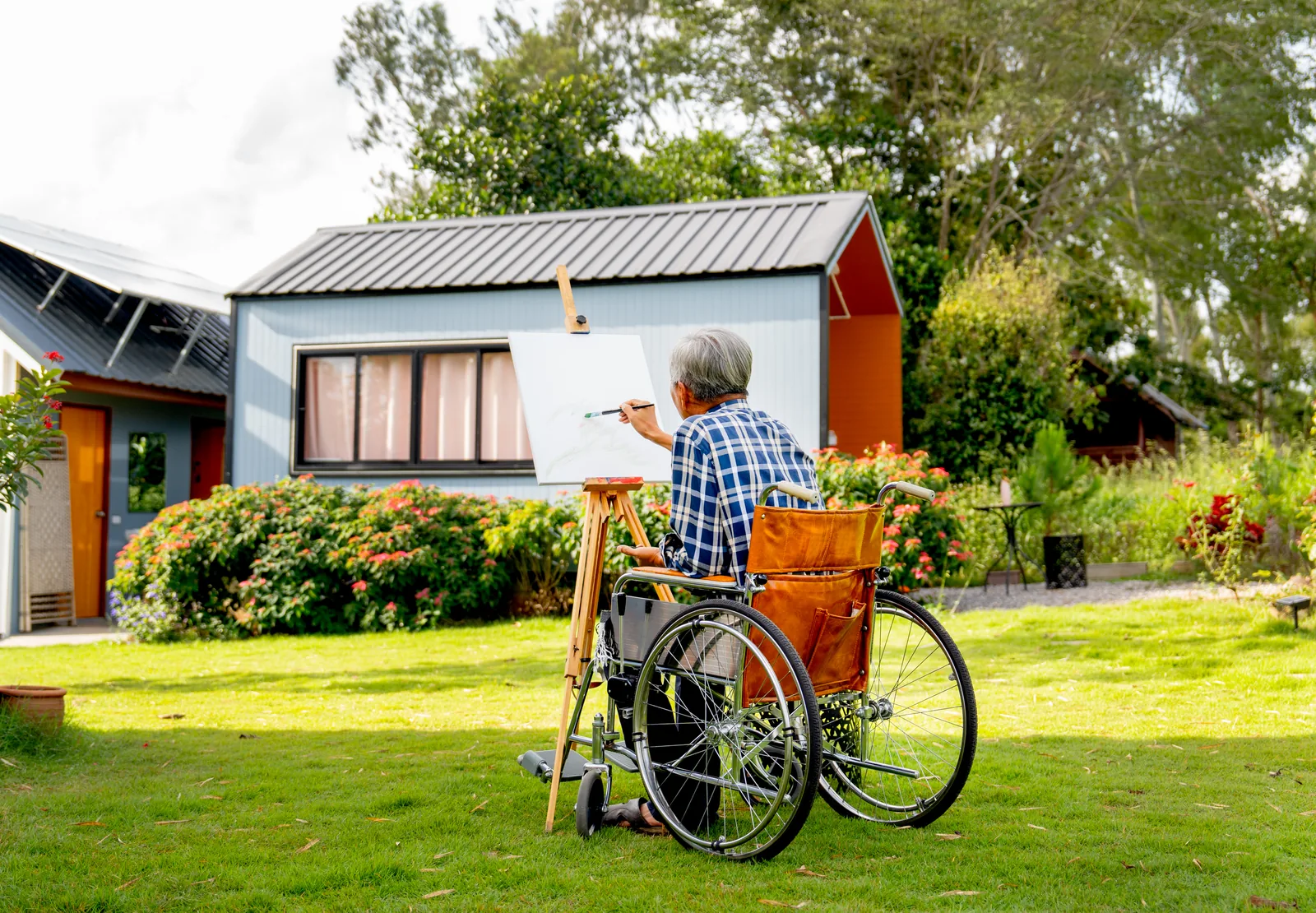
Both, and that is not an evasive answer. It concerns two things that are assessed separately: the building and its use. In many cases the building can stay permanently. Living in it independently is temporary, because that depends on the existence of an informal care relationship (mantelzorg: unpaid care for a family member or someone close to you).
That distinction explains almost all the confusion about this subject. One person hears that the home may stay and assumes someone may also keep living in it. Someone else hears that it is temporary and assumes the home has to be demolished afterwards. Neither is correct.
Two questions that get mixed up
| The building | Living in it independently | |
|---|---|---|
| What it depends on | The rules for ancillary buildings | The informal care relationship under the Wmo 2015 (Social Support Act) |
| Duration | Indefinite, as long as it fits within the rules | As long as care is being provided |
| If the care ends | May stay as an outbuilding | Lapses, unless the omgevingsplan (the municipality's zoning plan) allows it |
| Who assesses it | The municipality (gemeente), for the building activity | The municipality, for the use activity |
In practical terms this means: once the care has ended, there is a building in your garden that is allowed to stay, but in which nobody may live independently. The question then is what you do with it.
How long may it stay
The law sets no fixed term for a permit-free garden home (mantelzorgwoning). It does not say five or ten years are allowed; it says the use is linked to informal care. If the care lasts twelve years, the legal basis lasts twelve years.
That changes as soon as a permit is involved. If the municipality grants a permit for a fixed term, that term is stated in the decision and it simply applies. So when you apply for a permit, look specifically at this, and ask what happens if the care lasts longer than the permit.
In rural areas you will more often come across an extra condition: the municipality stipulates that the home is removed as soon as the care ends, sometimes laid down in an agreement. That is not harassment but policy against building over the countryside; it is, however, something to know before you buy rather than rent.
What happens when the care ends
There are three routes, and it is wise to choose one in advance rather than improvise afterwards.
- A different use. The building stays as a guest house, hobby room, workspace or storage. What is not allowed is for someone to go on living in it independently. This is explained in can it be converted into a guest house.
- Moving it. The home goes to a different address, with a crane, transport and a new foundation.
- Buy-back. The builder takes the home back. We buy back our own homes, refurbish them and offer them for sale again.
What is not on this list is renting it out to a third party. In planning terms that is a new independent dwelling, and that is rarely permitted in a back garden; the reasons are set out in may I rent out the home after the informal care has ended.
Why the duration cannot be planned
The question behind this page is usually not legal but practical: how long will we be doing this. There is little sensible to say about that, and that in itself is the answer.
A period of care can last two years or fifteen. Someone who temporarily cannot live alone after a hip operation sometimes recovers so well that years later the home is still in use as independent living space. And a situation that was expected to last for years can end within six months because of a single admission to a nursing home.
That is why the most important quality of this way of living is not the duration but the reversibility. A home that can be put in place in one day and removed again in one day suits a situation you cannot predict. An extension to the house suits it far less well, however nice it turns out; the trade-off is set out in is an extension a better alternative.
What the municipality checks afterwards
In most cases: nothing, until someone reports something. Municipalities have no system that keeps track of when a care situation ends, so in practice a check starts with a signal. That can be a neighbour, a registration in the population register or an advertisement offering the home for rent.
If there is a check, it is about the use and not about the building. The question is whether someone is living there independently without informal care still being provided. If that turns out to be the case, you first receive a letter with a deadline, and only after that an order subject to a penalty payment (last onder dwangsom). Anyone who can show at that point that there is a new care situation, or that the home is now used as a guest house, is quickly in the clear.
When it can become permanent
There is one route by which living there independently becomes permanent, and that is a permit for an omgevingsplan activity: permission for a permanent residential use on your plot. You apply for it at the municipality and it is assessed against the omgevingsplan.
Be realistic about the chances. In a back garden in a residential area this amounts to adding a dwelling, and municipalities manage that with policy on creating new homes and densification. On a large plot, or in a municipality that actively encourages splitting properties, the assessment may be different. So it is not impossible, but it is an application that needs a genuine justification.
Technical lifespan is something else
Alongside the legal question there is the structural one. How long does a home like this last? Our homes are timber-frame buildings, built indoors and designed as relocatable homes. That is a construction that lasts for decades, provided the roof and the joints are maintained as with any house.
What causes confusion is that the words temporary and relocatable are used interchangeably. Relocatable says something about how the home is built; temporary says something about how long it may be used in this location. A home can therefore be relocatable and of high quality at the same time, and that is exactly where it differs from a rental unit. See are there mobile garden homes.
What this means for your investment
Because the use comes to an end and the building does not, the question of residual value matters more than with an extension. A home that can be removed and that someone will buy back keeps its value. A building that can only be demolished is in practice written down to zero, and at the end it still costs money to dispose of.
That is why we agree the buy-back in advance instead of leaving it to the market. What a home is worth after years of use is explained in how much residual value a garden home has. If you are considering renting, this whole question does not arise: you give notice and the home is removed.
What to arrange in advance
- Find out what applies in your municipality to the use after the care has ended, and whether there is an obligation to remove the home.
- Choose your way out in advance: a different use, moving it or buy-back, and put it in the agreement.
- Keep the correspondence with the municipality. If there is a check years later, that is your file.
- Discuss it with the family. Otherwise the question of what happens to the home comes up at a moment when nobody wants to think about it.
If you want to know what applies at your own address, use the permit check. It also shows which rules your municipality sets for the use, and that is exactly the part where municipalities differ from one another. The other rules that come into play are explained in the municipality's most important rules.
Sources
- [Decree] Besluit bouwwerken leefomgeving (Bbl), ancillary buildings and residential use, consulted 20 August 2026
- [Act] Omgevingswet, art. 5.1, building activity and use activity are assessed separately, consulted 20 August 2026
- [Act] Wet maatschappelijke ondersteuning 2015, art. 1.1.1, definition of informal care, consulted 20 August 2026
- [Guidance] Informatiepunt Leefomgeving, temporary buildings and use under the Omgevingswet, consulted 20 August 2026
Curious what is allowed in your own garden?
The rules differ from one municipality to the next. Our free permit check looks up the rules that apply to your address. It takes two minutes and there is no obligation.