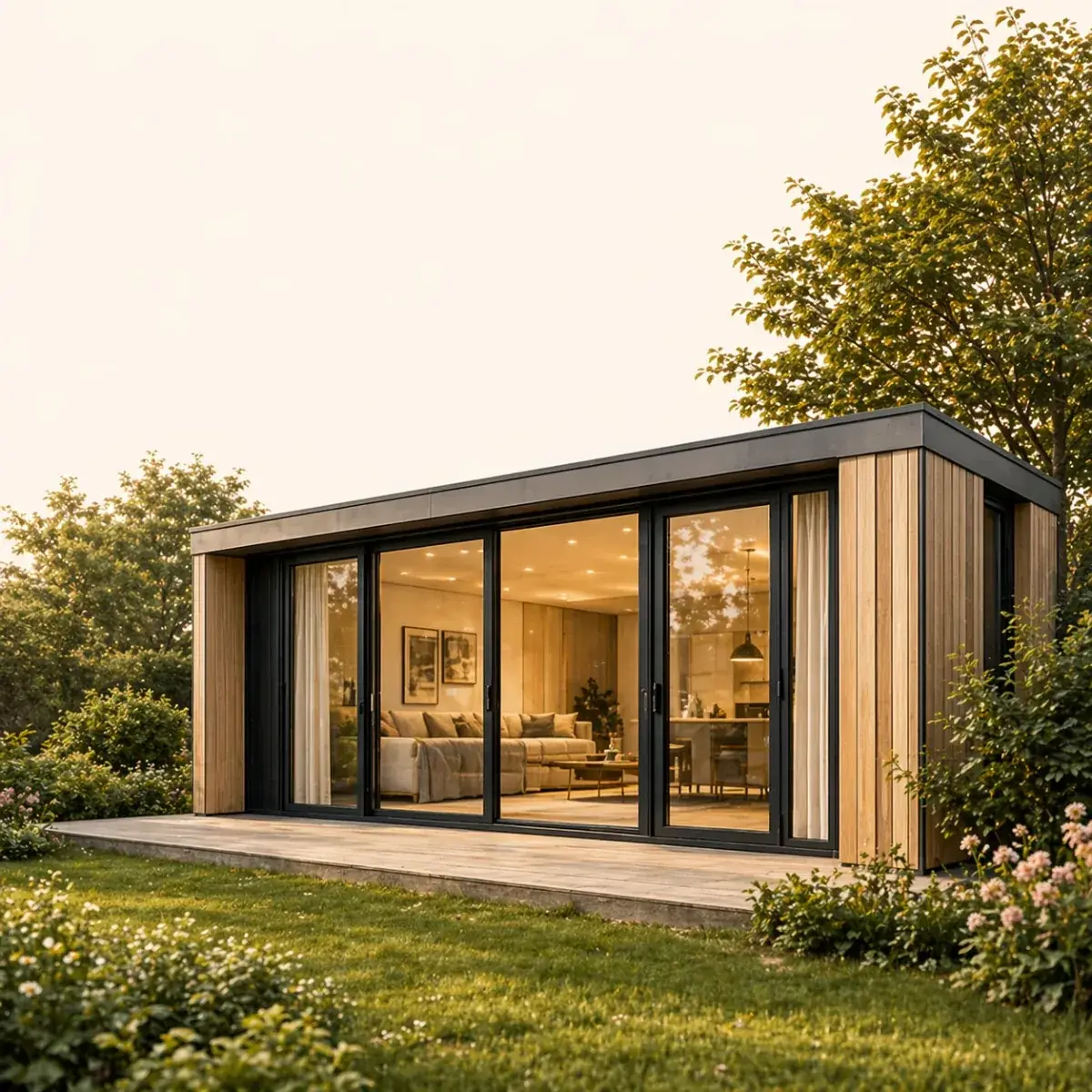
What happens to the garden home after the resident dies?
When the resident dies, the legal basis for living independently in the home no longer applies, because it depended on the informal care relationship. The structure can usually stay. There is no statutory deadline by which you must decide; municipalities apply a reasonable period. There are three routes: other use, relocating or buy-back.

When the resident dies, the legal basis for living independently in the home no longer applies. It depended on the informal care (mantelzorg) relationship, and that relationship no longer exists. In most cases the structure itself may simply stay where it is; what ends is its use as independent living accommodation.
What you do not have to do is decide anything straight away. The law sets no deadline, and in practice municipalities apply a reasonable period. Take that time. What you can do straight away: report it to the municipality and check the insurance.
What changes legally
Two things are assessed separately, and that explains why the answer to this question always comes in two halves.
| Before the death | Afterwards | |
|---|---|---|
| The structure | Ancillary building in the back garden | Unchanged; may remain |
| Living in it independently | Permitted because of the informal care | No longer applies |
| Other use | Not applicable | Allowed, provided nobody lives there independently |
| Renting it out to a third party | Not applicable | Almost always requires a permit, rarely permitted |
Why renting it out is not a way out is explained in can I rent out the home after the informal care has ended.
How much time you have
The law does not set a deadline. In practice municipalities look at whether the situation is resolved within a reasonable period, and what is reasonable depends on the circumstances. Nobody expects you to order a crane in the week of the funeral.
There are two exceptions in which there is a deadline. If a granted permit or an agreement with the municipality states that the home is to be removed once the care has ended, that arrangement applies, including the period it specifies. This mainly happens in rural areas (buitengebied). And if you rent the home, the notice period in your contract applies.
So check those documents before you assume there is no hurry. With us it is set out in the agreement, and we do not apply a deadline that puts you under pressure.
The three routes
What can happen to the home comes down to three options. It helps to talk through all three out loud before you choose.
- A different use. The building stays as guest accommodation, a spare room for visitors, a hobby room, a study or storage. What is not allowed is for someone to start living there independently again. See can it be converted into guest accommodation.
- Relocating. The home goes to another address, for example to a brother or sister where there is a need for care. Allow for a crane, transport and a new foundation.
- Buy-back or sale. The home goes back to the builder. We buy back our own homes, refurbish them and offer them for sale again.
How to choose between the three
The choice is usually determined by three questions, in this order.
Is there anyone else in the family who will need care? If that is likely in the foreseeable future, leaving the home where it is makes the most sense, even if it stands empty for a while. Relocating or selling it back and buying again later costs more than waiting.
Do you want to use the building yourself? A study, guest room or hobby room in the garden is a welcome outcome for many families, and in planning terms it is the simplest route. Do make sure that nobody lives in it independently any more; a house guest is not a resident, but a student who sleeps there all week is.
Or do you want your garden back? That is a legitimate reason and it happens more often than people dare to say. A building that reminds you of someone, visible from the kitchen every day, is not a comfort for everyone.
Who owns the home now
That depends on how it was arranged at the time, and it is the question that stirs up the most trouble in families.
If a right of superficies (recht van opstal, a right to own a building on someone else's land) was established through a notaris (civil-law notary), the home belonged to the person who paid for it. If that person dies, the home becomes part of the estate and the heirs decide together, with the erfbelasting (inheritance tax) that goes with it.
If nothing was recorded, the home has become the property of the owner of the land through accession (natrekking). If the deceased paid for the home while it stands on the property of one of the children, that child is already the owner. That can create an imbalance in the division of the estate with brothers and sisters, and it is exactly the discussion a right of superficies would have prevented. The background is set out in the tax page.
If the estate is being handled by a notaris, put the question to them before anything happens to the home. Selling a home that still belongs jointly to the heirs causes problems later on.
What needs to be arranged in practice
A short list for the first weeks. Nothing more is needed.
- Report it to the municipality, to the department that deals with the permit or with enforcement. Ask straight away what they consider a reasonable period and have that confirmed in writing.
- Check the buildings and contents insurance. An unoccupied home sometimes falls under different terms, especially if it stands empty for a longer period.
- Do not switch the heating off completely in winter. Frost damage to pipes is an expensive and avoidable setback.
- Leave the utility connections in place for now until you know which route it will be; reconnecting costs more than continuing to pay.
- Keep the paperwork. Drawings, correspondence with the municipality and the completion documents for the installations. You will need them for a sale, buy-back or relocation.
Deregistration from the basisregistratie (the municipal personal records database) happens automatically through the death certificate; you do not need to do anything for that.
If the home was rented
If you rented the home, the situation is simpler and at the same time tighter. The rental agreement continues until it is terminated, so the first step is to check the notice period. The landlord then collects the home; the groundwork and restoring the garden are usually at your expense, unless something else was agreed.
With us the contract renews automatically until you give notice, precisely because a care situation cannot be planned. So you do not have to do anything at the moment itself; a phone call when you are ready is enough.
If a new care situation arises
This is underestimated. The home is not tied to one person, but to the existence of informal care. If a new need for care arises in the family, for example for the other parent or a parent-in-law, the home can fulfil that function again.
Do report this to the municipality, though, and make sure the supporting evidence is sound. What does not work is constructing a care relationship in order to keep the home; municipalities know that route and check for it.
What we do
We buy back our own homes when care ends, and that is set out in the agreement in advance instead of having to be negotiated afterwards. It is intended for exactly this moment: you do not have to look for a buyer at a time when you have no head for it.
What the home is worth then is set out in how much residual value a garden home (mantelzorgwoning) has. And if you are still considering a home, this is the question to ask at the beginning rather than at the end: record what happens when it comes to an end.
Sources
- [Decree] Besluit bouwwerken leefomgeving (Bbl, Buildings Decree) — ancillary buildings and residential use — accessed 20 August 2026
- [Act] Omgevingswet (Environment and Planning Act) — art. 5.1 — building and use are assessed separately — accessed 20 August 2026
- [Act] Burgerlijk Wetboek Boek 5 (Dutch Civil Code, Book 5) — art. 5:20 (accession, natrekking) and title 8 (right of superficies, recht van opstal) — accessed 20 August 2026
- [Act] Successiewet 1956 (Inheritance Tax Act) — inheritance tax and the estate — accessed 20 August 2026