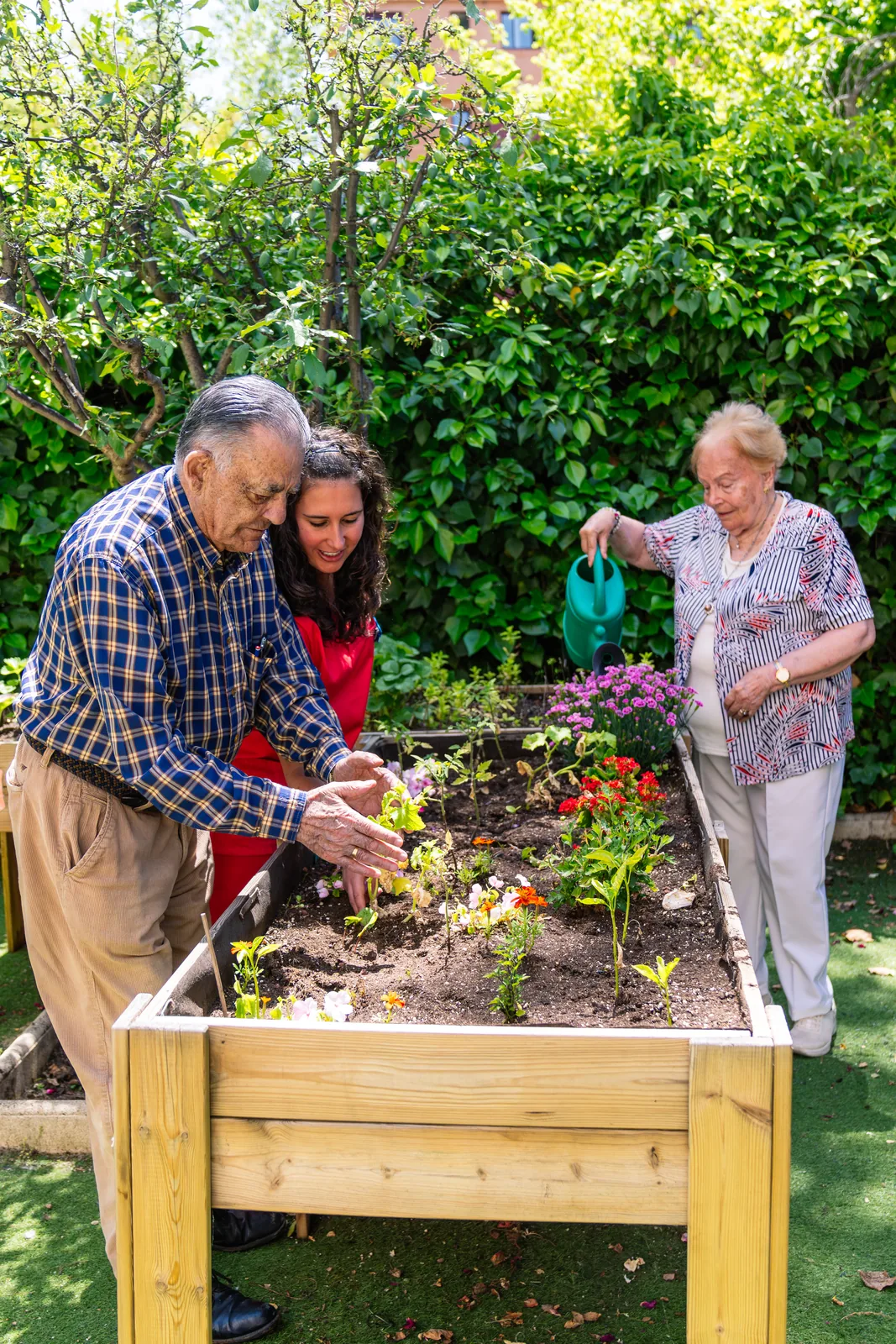
Bringing elderly parents to the Netherlands: care, housing and residence
There is no standard residence permit for a parent from outside the EU, and a parent on a visitor visa has no access to Wmo or Wlz care. What the residence routes really are, how care works once your parent lives here, and which housing options close to you make sense.

Bringing elderly parents to the Netherlands is harder than most expats expect. For a parent from outside the European Union there is no standard residence permit, and a parent who is here on a visitor visa has no access to the Dutch care system. For a parent from an EU country the door is open, but with conditions on income and insurance.
This page follows the order in which things have to be settled: first residence, then insurance and care, then housing. Getting that order wrong is where the expensive mistakes happen.
Residence routes for a parent from outside the EU
Visiting on a short-stay visa
A Schengen visa allows a stay of up to 90 days in any 180-day period. The standard visa fee for adults is €90. In practice, that means a parent can spend two separate 90-day blocks with you in a year, for example January to March and July to September, with 90 days away in between.
A visit is not a way to move here. The IND (the Dutch immigration service) only extends a short stay in a special and unexpected situation, such as serious illness or circumstances beyond your control.
Residence under Article 8 ECHR
The IND lists no separate permit for a dependent parent. A parent who wants to live with an adult child can only apply under Article 8 of the European Convention on Human Rights, the right to family life. The IND itself says this is almost never granted, especially when family life is also possible in the parent's own country or another safe country. It advises you to call the IND before applying.
Under the Dutch Aliens Circular, the IND only accepts family life between adults when there are extra elements of dependency beyond normal emotional ties. IND guidance names the factors it weighs: whether you live together, financial and emotional dependency, health, and ties with the country of origin. It also looks at whether other relatives or professional carers could provide the care there. A parent who needs help but has a sibling of yours nearby is, on that reasoning, a weak case.
If you are a citizen of another EU country
This is the route many expats overlook. If you are, say, a German or Spanish national living in the Netherlands, your non-EU parent can apply for verification against EU law as your family member. The conditions:
- Your parent is financially dependent on you or your spouse: without your money they cannot pay for basic needs, and you send money regularly.
- You have legal residence here, with health insurance and sufficient income.
- The application is made from within the Netherlands, costs €85, and the IND has 6 months to decide. A positive decision gives a residence document valid for 5 years.
A Dutch national only falls under EU law after using free movement, for example by living in another EU country first. And note the IND's warning: if your parent applies for public funds such as social assistance, their legal residence can be ended.
Parents who are EU, EEA or Swiss citizens
An EU, EEA or Swiss citizen can stay in the Netherlands for 3 months without further conditions. A parent who stays longer and does not work needs income at least at the level of the Dutch minimum wage including holiday pay, which may come from a pension or from you. They need health insurance, and must register at the town hall if they stay longer than 4 months. After 5 years of meeting these conditions, they have permanent residence.
How care works once your parent lives here
Three systems pay for most care for older people. Which one applies depends on the kind of help, and all three depend on your parent's residence status.
| System | What it covers | Who arranges it | Access |
|---|---|---|---|
| Zvw (health insurance) | GP, hospital, medication | A health insurer | Compulsory for everyone insured under the Wlz |
| Wmo (Social Support Act) | Support at home, day activities, respite for carers | The municipality | Residents with lawful residence |
| Wlz (Long-term Care Act) | Permanent supervision or 24-hour care nearby, including nursing homes | CIZ assesses, then the regional zorgkantoor | Wlz-insured people with an indication |
Wmo. You report the need to the municipality, which must investigate within six weeks. After a formal application it decides within two weeks. In 2026 most Wmo support costs a contribution of at most €21.80 per month.
Wlz. The CIZ (the national assessment centre) decides whether someone has a lasting need for permanent supervision or 24-hour care nearby, in principle within 6 weeks. The CIZ does not provide care itself. Wlz care comes with its own personal contribution.
Insurance is not automatic. Registering at a Dutch address does not by itself make your parent insured under the Wlz. The SVB, which assesses this, looks at how long someone has been here and why they came. Someone moving here for the first time is not automatically insured, and a parent who receives a long-term pension from another EU country is normally not Wlz-insured at all. Their care then runs through the pension country, sometimes via a treaty policy with the insurer CZ. You can ask the SVB for a formal assessment.
The pitfall of care on a visitor visa
The Wmo and the Wlz both limit access for non-EU nationals to specific kinds of lawful residence: a residence permit, or residence under EU free movement rules. A visa-free or short-stay visit is not on that list, and neither is waiting for a decision on an application.
So a parent who is here on a visit, or who has applied under Article 8 and is waiting, cannot get home support from the municipality or a nursing home place through the Wlz. According to the SVB, someone who comes to visit family is probably not Wlz-insured, and the obligation to take out Dutch health insurance follows from Wlz insurance. If your parent's health declines during a visit, the costs are private or fall on a travel insurance policy.
Housing options close to you
- In your own home. The simplest start, but often too small once care increases.
- Senior housing (aanleunwoning). An independent, usually rented home near a care organisation. The minimum age is usually 55 or 65, and you often register with the municipality. Care comes through the Wmo or the Wlz.
- A nursing home. Only with a Wlz indication from the CIZ, after which you look for a provider through the zorgkantoor.
- A garden home (mantelzorgwoning) in your back garden. Your parent lives independently, a few metres away.
The rules for a garden home
A garden home for informal care (mantelzorg) can be permit-free on the back of your plot. It is meant for one household of at most two people, of whom at least one gives or receives informal care. When the care ends, the use has to go back to what it was before.
The Dutch government expects that from 1 January 2027 a family home in the back garden will also be permit-free, without a care relationship, for first-degree relatives such as parents. The expected conditions: at most 5 metres high, a pitched roof above 3 metres, and a maximum area depending on the plot, up to 150 m². This is not yet in force.
A worked example
Say the built-up area behind your house, roughly your back garden, measures 200 m². Up to 100 m², half may be built on. Above that, 20% of the extra area is added. That gives 50 + 20 = 70 m² for all outbuildings together. If a 12 m² shed already stands there, 58 m² remains. Our Vink model measures 12.00 × 4.20 metres, 50.4 m² gross, and fits within that space. Whether it fits on your plot also depends on your municipality's rules, which you can check with the permit check. You can compare sizes on the homes overview, and read more about garden homes for international families.
A decision framework for your situation
| Your situation | Realistic route | First step |
|---|---|---|
| Your parent is an EU, EEA or Swiss citizen | Free movement, with income and insurance | Check health insurance, and ask the SVB about Wlz if they have a foreign pension |
| You are a non-Dutch EU citizen, your parent is non-EU and depends on you financially | Verification against EU law | Collect proof of regular financial support |
| You are Dutch or non-EU, your parent is non-EU | Article 8 ECHR, rarely granted | Call the IND and consult an immigration lawyer |
| Residence is not possible | Visits of up to 90 days in 180 | Arrange private travel insurance |
One rule holds across all four: settle residence before you commit to housing. A garden home is a large, long-term purchase. If an Article 8 application is refused, your parent can only visit, and a garden home for informal care cannot be lived in permanently by someone who has no right to live here.
Sources
- IND, Residence permit article 8 ECHR family life
- IND, Family and partner residence permits
- IND, Verification against EU law for Union citizen family members
- IND, Staying in the Netherlands as an EU, EEA or Swiss citizen
- IND, Extend Schengen visa or visa-exempt term
- Government.nl, How do I apply for a short-stay Schengen visa?
- European Commission, Applying for a Schengen visa
- Vreemdelingencirculaire 2000 (B), paragraph B7/3.8
- Vreemdelingenwet 2000, article 8
- Wet maatschappelijke ondersteuning 2015, articles 1.2.1, 1.2.2, 2.3.2 and 2.3.5
- Wet langdurige zorg, articles 2.1.1 and 3.2.1
- Zorgverzekeringswet, article 2
- Government.nl, Standard health insurance
- SVB, You are resident in the Netherlands (Wlz)
- SVB, You receive a pension or benefit (Wlz)
- CAK, Eigen bijdrage Wmo €21,80 in 2026
- Regelhulp, Wlz-zorg aanvragen
- Regelhulp, Aanleunwoning
- Zorgkantoor.nl, Het CIZ
- Informatiepunt Leefomgeving, Mantelzorgwoning en Omgevingswet
- Informatiepunt Leefomgeving, Vergunningvrije bijbehorende bouwwerken
- Volkshuisvesting Nederland, Kortere procedures
This page explains the general rules and is not legal or immigration advice. Residence decisions depend on your personal circumstances and the rules can change. For your own situation, contact the IND or an immigration lawyer, and the SVB or your municipality for questions about insurance and care.