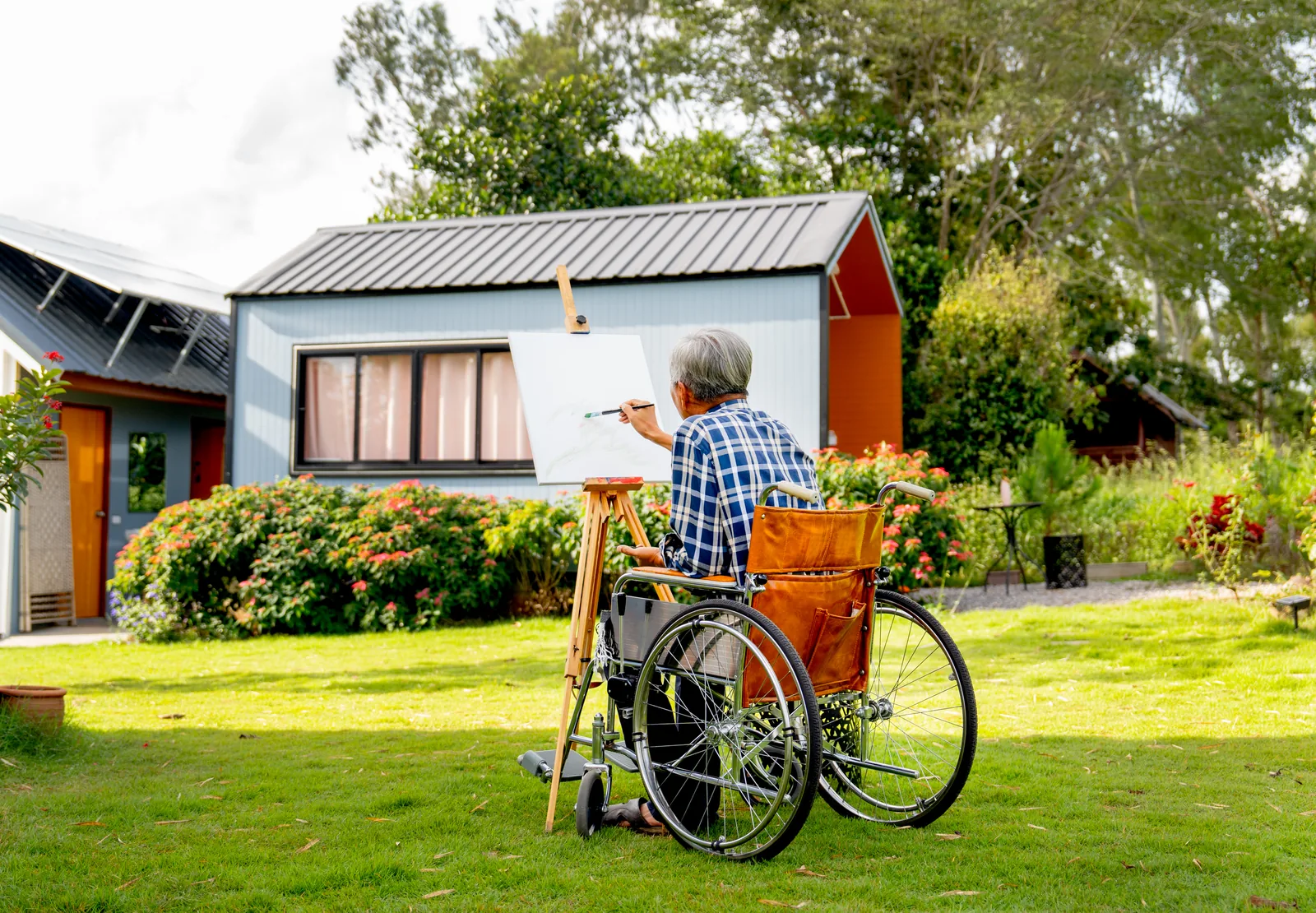
What mantelzorg and mantelzorgwoning mean in English
Mantelzorg is the Dutch word for informal care: help you give someone because of a personal relationship, not as a job. This page explains the legal meaning, what being a carer (mantelzorger) gives you in practice, what a mantelzorgwoning is, and the Dutch terms you will meet at your municipality or employer.

Mantelzorg is the Dutch word for informal care: the help you give a partner, parent, child, friend or neighbour who needs care, because of your personal relationship with them and not as a job. The person who gives it is a mantelzorger, usually translated as informal carer or simply carer. You will meet the word at your municipality, in your employment contract and on almost every Dutch website about care for older people.
The word matters because Dutch law attaches rights and permissions to it, including when you may build a mantelzorgwoning (garden home) without a permit.
What mantelzorg means in Dutch law
The Social Support Act (Wmo 2015) defines mantelzorg as help that comes directly from a social relationship between people and is not given as part of a care profession. Two things follow from that definition.
- It is not professional care. A home care nurse doing her job is not a mantelzorger.
- It is not organised volunteering. The Dutch government explains that a volunteer helps someone through an organisation, such as a foundation or charity. If you care for a sick relative or friend, you are a mantelzorger, not a volunteer.
According to the government, mantelzorg is usually unpaid, usually long-term and can be intensive. It also goes further than the help people in one household normally give each other. The Wmo calls that ordinary help gebruikelijke hulp: what can reasonably be expected from a spouse, parents, children living at home or other housemates. Cooking for your partner is not mantelzorg; washing and dressing your partner every morning can be.
Unpaid does not always mean without money. The government notes that some carers are paid from the personal budget (pgb) of the person they look after.
Why no English word fits exactly
"Informal care" and "carer" describe the same activity, but in English they are everyday words without a legal threshold. In the Netherlands, mantelzorg is a defined term, and the definition changes with the law you are dealing with.
For support from your municipality, the broad Wmo definition applies. For a garden home, the building rules use a stricter one: the care must be intensive, go beyond ordinary household help, and the need for it must be something you can demonstrate. So you can be an informal carer in the everyday sense and still not meet the definition that allows a home in your back garden.
How many carers there are
The Netherlands Institute for Social Research (SCP) found that 39 percent of Dutch people gave informal care in 2024, which is more than 5.5 million people. In 2014 the share was 33 percent. The SCP counts everyone who helped someone they know with health problems in the previous twelve months.
What being a mantelzorger gives you in practice
Care leave from your employer
If you are an employee in the Netherlands, the Work and Care Act (Wet arbeid en zorg) gives you two kinds of care leave (zorgverlof), counted per 12 months:
- Short-term care leave (kortdurend zorgverlof): at most twice your weekly working hours. Your employer pays at least 70 percent of your salary, and never less than the statutory minimum wage.
- Long-term care leave (langdurend zorgverlof): at most six times your weekly working hours. Your employer does not have to pay your salary for these hours.
An example: you work 40 hours a week. You can take up to 80 hours of short-term care leave and up to 240 hours of long-term care leave in 12 months. Your collective labour agreement (cao) may offer better pay during leave, so check it before you apply.
Support from your municipality
Support for carers is a task of the municipality (gemeente) under the Wmo. The law requires municipalities to:
- make policy that helps carers keep up their caring role, and offer general support measures for them;
- look at the carer's own need for support when they assess someone who asks for help;
- arrange an annual token of appreciation for carers (mantelzorgwaardering). What that token is, and how you apply for it, is set by each municipality.
You ask for this support at the Wmo desk (Wmo-loket) of the municipality. The municipality must also offer free independent client support (cliëntondersteuning) to help you find your way.
Respite care
Respite care (vervangende zorg or respijtzorg) means someone else takes over the care for a while, so you can rest, travel or deal with your own health. Professional respite care is paid by the municipality, the regional care office (zorgkantoor) or the health insurer, depending on the care the person already receives.
What a mantelzorgwoning is
A mantelzorgwoning is a separate home next to the house of either the carer or the person who needs care, so the two live close together while keeping their own front door. On this site we call it a garden home. For a fuller explanation, read what a mantelzorgwoning is exactly.
Under the Environment and Planning Act (Omgevingswet), housing in connection with informal care is defined as housing in or next to a home for one household of at most two people, at least one of whom gives care to, or receives care from, a resident of the main house.
When it can be built without a permit
Under the current rules, a garden home can in many cases be placed permit-free (vergunningvrij) in the back garden area (achtererfgebied). This follows from the technical rules in the Besluit bouwwerken leefomgeving and from standard rules (articles 22.27 and 22.36) that were added to every municipal environmental plan (omgevingsplan). Municipalities can change those standard rules in their own plan, so the local rules always need checking. Our permit check shows what applies at your address.
Two conditions are easy to miss:
- The care must be provable. In the building rules, the need for care must be demonstrable with a statement from a GP (huisarts), a district nurse (wijkverpleegkundige) or another social-medical adviser designated by the municipality.
- The permission lasts only as long as the care. When the informal care ends, the use of the property must return to one household, and temporary structures have to be removed.
Who can live in such a home is explained in who a mantelzorgwoning is intended for.
The family home expected from 2027
The Dutch government is widening these rules. A home on your own plot for informal care, or as a family home (familiewoning) for first-degree relatives such as parents or children, will become permit-free under conditions. The decree with the detailed rules is expected to take effect on 1 January 2027. From then on, according to the ministry, a care statement will no longer be needed in advance for a garden home, although the municipality may ask for proof if there is genuine doubt about the care relationship.
Dutch terms you will come across
| Dutch term | What it means in English |
|---|---|
| mantelzorg | Informal care: help given because of a personal relationship, not as a job or through an organisation |
| mantelzorger | Informal carer; the person who gives mantelzorg |
| mantelzorgwoning | Garden home: a separate home near the carer or the person cared for, linked to an informal care relationship |
| zorgverlof | Care leave from your employer, short-term (partly paid) or long-term (unpaid) |
| Wmo | Social Support Act; the law under which your municipality provides support at home and support for carers |
| Wlz | Long-Term Care Act; covers people who need intensive care or supervision permanently, in a nursing home or at home |
| CIZ | The national body that assesses whether someone qualifies for care under the Wlz |
| gemeente | Municipality; your first point of contact for the Wmo, carer support and building rules |
| vergunningvrij | Permit-free; you may build without an environmental permit if all conditions are met |
| achtererf | Back garden; in the rules, the back garden area behind the front line of the main house |
Sources
- Wetten.overheid.nl: Wet maatschappelijke ondersteuning 2015
- Wetten.overheid.nl: Wet arbeid en zorg
- Rijksoverheid: Wanneer ben ik mantelzorger?
- Regelhulp (Ministry of VWS): Wat is mantelzorg?
- SCP: Mantelzorg in beweging. Kerncijfers en trends 2014-2024 (21 May 2026)
- Rijksoverheid: Hoe lang kan ik zorgverlof opnemen?
- Rijksoverheid: Wat betekent zorgverlof voor mijn salaris?
- Regelhulp: Mantelzorgondersteuning
- Regelhulp: Vervangende zorg (respijtzorg)
- Rijksoverheid: Waar kan ik een Wlz-indicatie aanvragen?
- CIZ: Long-Term Care Act
- IPLO: Mantelzorgwoning en Omgevingswet
- IPLO: Vergunningvrije bijbehorende bouwwerken
- Volkshuisvesting Nederland: Kortere procedures
This page is general information about Dutch rules and terms. Your rights to leave, support and building without a permit depend on your personal situation, your employer and your municipality, so it is not personal legal or financial advice.